
GK Technology Podcast
Ag Geek Speak: the precision ag podcast from GK Technology.
Host Sarah Lovas talks precision agriculture, ag mapping, agronomy, and drainage with the people doing the work. Full interview episodes and short Tiny Bytes explainers, all in one feed.

GK Technology Podcast
Ag Geek Speak: the precision ag podcast from GK Technology.
Host Sarah Lovas talks precision agriculture, ag mapping, agronomy, and drainage with the people doing the work. Full interview episodes and short Tiny Bytes explainers, all in one feed.
About the show
One podcast, two formats.
Ag Geek Speak is the podcast from GK Technology, the precision ag software and mapping company in Halstad, Minnesota. Every episode is published to one feed, so you get both formats wherever you listen.

Interviews and deep dives
Long-form conversations with agronomists, soil scientists, software developers, and growers on precision agriculture: variable rate, soil sampling, imagery, drainage, AI on the farm, and the people building the tools.
Browse full episodes
One precision ag topic, explained
Tiny Bytes are the short episodes of Ag Geek Speak. Each one answers a single question, from what a shapefile is to how Olsen, Bray, and Mehlich-3 phosphorus tests differ. They are numbered with a .5 between the full episodes.
Browse Tiny Bytes
Your host
Sarah Lovas is a member of the GK Technology team. She hosts every episode, brings in guests from across the industry, and takes topic requests from listeners through the form below.
Episodes
Every episode, newest first.
Filter by format, open the show notes, read the transcript, or press play. New episodes appear here automatically when they publish.
Showing 1 to 12 of 41 episodesNewest first

8.5 Tiny Bytes Soil Electrical Conductivity Made Simple
We trade puns and practical advice while breaking down what soil electrical conductivity really measures and why soils can carry electrical current. We compare lab EC numbers to on-the-go EC mapping so…
Show notes
We trade puns and practical advice while breaking down what soil electrical conductivity really measures and why soils can carry electrical current. We compare lab EC numbers to on-the-go EC mapping so you can spot salinity risk without over-reading a single map layer.
In this episode we talk
• soil electrical conductivity defined as soil water carrying current
• soluble salts as a major driver of EC and why saltier water conducts better
• other EC influences including porosity, texture, clay mineralogy, moisture, temperature, and organic matter
• how cation exchange capacity ties into conductivity in clay and organic matter
• lab EC as a standardized measurement that supports comparison across fields and years
• on-the-go EC mapping as a way to see field variability while staying mindful of non-standard conditions
• Va=eris depth measurements using discs and why dry soils can distort results
• EM38 and magnetic susceptibility plus why it may handle dry soil differently
• calibrating EC maps with soil cores and lab tests to understand what variability means
• interpreting soil test EC thresholds such as EC over 4 dS/m being considered saline in NDSU guidance
Tune in next time for a tiny bite of knowledge from GK Technology, where we have a map and an app for that.
Other episodes mentioned:
S2E17.5 Cracking the Code of Salty Soils https://www.buzzsprout.com/2297340/episodes/18217995
https://gktechinc.com/

7.5 Tiny Bytes: Penetrometers and the Real Cost of Compacted Soil
We dig into why soil compaction is more than “hard ground” and how it quietly limits roots, water, and oxygen in ways that can cut yields. We also walk through how a…
Show notes
We dig into why soil compaction is more than “hard ground” and how it quietly limits roots, water, and oxygen in ways that can cut yields. We also walk through how a penetrometer works, what PSI numbers actually mean, and how to take readings that do not fool you.
In this episode we talk about...
• soil compaction as reduced pore space and increased root resistance
• common field hotspots like headlands and wet-traffic scars
• impacts on oxygen movement, water uptake, root depth, drought resilience, and fuel use
• why compaction severity varies and how that changes tillage decisions
• penetrometers, cone index readings, and what 200 PSI and 300 PSI suggest
• texture changes in the soil profile that can feel like compaction
• best timing for testing at field capacity and why wet or dry soil skews results
• sampling tips like steady pressure, avoiding tracks unless diagnosing, and clearing surface litter
Tune in next time for a tiny bite of knowledge from GK Technology, where we have a map and an app for that.
https://gktechinc.com/

6.5 Soil Sample the Extremes
We dig into why skipping the lowest-yielding parts of a field can be the most expensive soil sampling decision you make. We lay out a simple “sample the extremes” plan that improves…
Show notes
We dig into why skipping the lowest-yielding parts of a field can be the most expensive soil sampling decision you make. We lay out a simple “sample the extremes” plan that improves variable-rate fertilizer accuracy and helps put nutrients where they actually belong.
In this episode we discuss...
• reframing soil testing as nutrient placement, not just cost-cutting
• why red zones like hilltops, saline spots, and drown-outs often need sampling most
• how built-up phosphorus and potassium can hide in low-productivity areas
• using variable rate yield goals alongside soil test results for tighter fertilizer decisions
• choosing which management zones to sample and when to interpolate the rest
• splitting low zones into separate mods and sampling both when causes differ
• using ADMS to bring results back into zones and make educated interpolations
Tune in next time for a tiny bite of knowledge from GK Technology, where we have a map and an app for that.
https://gktechinc.com/

05.5 Don't Guess, Soil Test - Fall 2026 Soil Sample Preview
We’re staring at a messy fall where fertilizer prices are high, crop prices feel tight, and it’s not obvious what rotation makes the most sense next spring. We can’t control the markets…
Show notes
We’re staring at a messy fall where fertilizer prices are high, crop prices feel tight, and it’s not obvious what rotation makes the most sense next spring. We can’t control the markets or the weather, but we can find out what’s actually in our soil and make the most informed economic call.
In this Tiny Byte, we talk
• why 2026 feels like a high-stakes soil sampling year
• how fertilizer price uncertainty changes fall vs spring decisions
• drought vs flooding effects on mobile nutrients like nitrate nitrogen
• what drowned-out zones can mean for denitrification and leftover N
• lessons from prevent plant acres and mineralization turning organic matter into nitrate
• why phosphorus and potassium tests matter when P and K are expensive
• using soil test data to guide rotation choices and reduce risk
Don't guess. Soil test.
Tune in next time for a tiny bite of knowledge from GK Technology, where we have a map and an app for that.
https://gktechinc.com/

4.5 Tiny Bytes: The 5% That Runs The Soil
We break down what soil organic matter really is, from living microbes to old, dark humus that can take years to form. We also explain why that small slice of soil drives…
Show notes
We break down what soil organic matter really is, from living microbes to old, dark humus that can take years to form. We also explain why that small slice of soil drives soil health through better structure, nutrient cycling, and water holding capacity.
We discuss
• defining soil organic matter as the biological legacy of a field
• connecting soil composition to the “critical” 5% organic fraction
• explaining humus as a stable end product of decomposition
• improving soil aggregation and aggregate stability for better structure
• boosting water retention and water holding capacity
• increasing negative charge and cation exchange capacity to hold nutrients
• chelating micronutrients like iron, copper, and zinc for plant availability
• releasing nitrogen, phosphorus, and sulfur through organic matter breakdown
• feeding soil microbes by expanding the soil food buffet
• building organic matter with compost, residue, manure, cover crops, and reduced tillage
Tune in next time for a tiny bite of knowledge from GK Technology, where we have a map and an app for that.
https://gktechinc.com/
3.5 Tiny Bytes: Landsat vs Sentinel for NDVI and Variable-Rate Maps
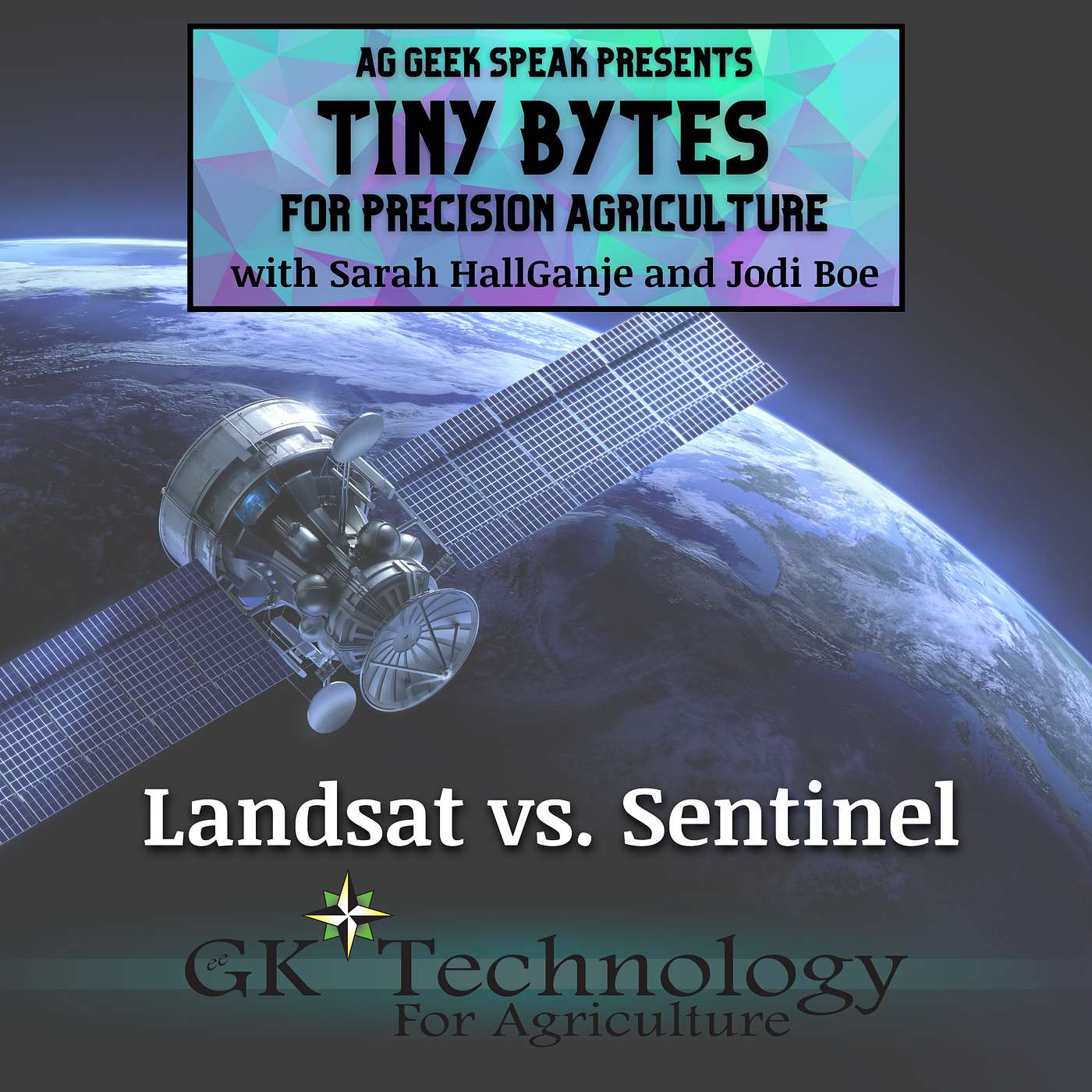
We take a practical trip into satellite imagery and explain how Landsat and Sentinel support real agronomy work like NDVI analysis and variable rate mapping. We break down what makes these datasets…
Show notes
We take a practical trip into satellite imagery and explain how Landsat and Sentinel support real agronomy work like NDVI analysis and variable rate mapping. We break down what makes these datasets reliable, how resolution changes what you can see, and why revisit timing matters when clouds get in the way.
In this episode, we tackle:
• free government-operated imagery through NASA USGS and the European Space Agency
• using multi-band satellite data to calculate NDVI for crop vigor mapping
• why sun-synchronous orbits create consistent lighting and shadows
• resolution explained as ground area per pixel and why 10 m shows more detail than 30 m
• Landsat program timeline and the Landsat 7 data gap problem
• constellations as a backup plan and a way to increase image frequency
• Sentinel revisit cadence vs Landsat revisit cadence and what that means during the season
Tune in next time for a tiny bite of knowledge from GK Technology, where we have a map and an app for that.
Related episodes:
- S1 20.5 Tiny Bytes: Choosing Quality Imagery https://www.buzzsprout.com/2297340/episodes/16135793
- S2 1.5 Tiny Bytes: Check Out GK Technology's Imagery Library https://www.buzzsprout.com/2297340/episodes/16524859
GK Technology Info on obtaining satellite imagery: https://gktechinc.com/data-links/
https://gktechinc.com/

02.5 Zone Soil Sampling: Making Fertilizer Dollars Go Farther
In this episode, Sarah and Jodi dig into why zone soil sampling pays off when fertilizer prices are high and every pound has to earn its keep. We explain why composite soil…
Show notes
In this episode, Sarah and Jodi dig into why zone soil sampling pays off when fertilizer prices are high and every pound has to earn its keep. We explain why composite soil sampling can hide field extremes and how better sampling leads to smarter variable rate fertility prescriptions.
We talk:
• high fertilizer prices driving interest in variable rate fertilizer and better prescriptions
• composite soil samples providing an average while hiding extremes like low pH pockets
• pH variability on sandy ridges and why missing it increases yield and input risk
• sampling every zone at least once to build a dependable baseline
• sampling high and low productivity zones to capture the true spread
• low productivity areas often holding excess phosphorus and potassium from years of flat-rate applications
• using soil test data to cut back safely in poor zones and reallocate dollars to higher return acres
Tune in next time for a Tiny Byte of Knowledge from GK Technology, where we have a map and an app for that.
https://gktechinc.com/

0.5 Tiny Bytes - Value of NAIP Imagery In Ag Mapping
Sarah and Jodi discuss NAIP aerial imagery and why this high-resolution imagery is invaluable for precision agriculture work in the United States. They share workflows for validating zones, aligning layers, and spotting…
Show notes
Sarah and Jodi discuss NAIP aerial imagery and why this high-resolution imagery is invaluable for precision agriculture work in the United States. They share workflows for validating zones, aligning layers, and spotting year-over-year patterns while noting timing pitfalls, thanks to NAIP imagery as a background source.
In this episode, we discuss...
• what NAIP is and who collects it
• benefits of high resolution often associated with newer NAIP imagery
• four-band imagery (RGB with NIR) enabling NDVI
• leaf-on timing and when imagery misleads
• state-by-state differences in resolution and frequency
• FSA and CLU uses that ensure strong georeferencing
• practical steps to draw boundaries and validate zones
• aligning offset satellite layers to NAIP
• leveraging multi-year NAIP to confirm stable patterns
• free access and where to get the data
Tune in next time for a Tiny Byte of knowledge from GK Technology, where we have a map and an app for that
https://gktechinc.com/

19.5 Map The Acidity, Save The Harvest
We dig into why low (acidic) soil pH unlocks aluminum toxicity, how that halts root growth, and which crops suffer first. Then we lay out a practical plan to find acidic patches…
Show notes
We dig into why low (acidic) soil pH unlocks aluminum toxicity, how that halts root growth, and which crops suffer first. Then we lay out a practical plan to find acidic patches with smarter sampling, NDVI, and grid-the-zone strategies, and point to lime and buffer pH for the fix.
In this episode, we discuss...
• soil pH as chemical control and pH level of 7 is neutral
• aluminum toxicity risk to crops increases below 6.5 pH
• wheat relatively tolerant, legumes struggle with nodulation
• stunted roots and thin stands on slopes and sandier spots
• acidic areas are patchy and do not always follow productivity maps
• importance of using intensive grids and how 0–3 inch sampling in no-till helps detect acidicity issues
• soil testing: pair pH with buffer pH to set lime rates
• target NDVI-low areas and grid inside zones
• variable-rate lime as the remediation path
Gridding the Zone with Ag Genesis Part 1: https://www.buzzsprout.com/2297340/episodes/16692855
Gridding the Zone with Ag Gensis Part 2:
https://www.buzzsprout.com/2297340/episodes/16692855
Tune in next time for a Tiny Byte of knowledge from GK Technology, where we have a map and an app for that.
https://gktechinc.com/

18.5 Is There a Way to Predict IDC Risk?
We unpack why soybean leaves turn yellow in patches, thanks to soybean IDC (iron deficiency chlorosis) and how to predict IDC risk for management. We share the exact soil tests that matter,…
Show notes
We unpack why soybean leaves turn yellow in patches, thanks to soybean IDC (iron deficiency chlorosis) and how to predict IDC risk for management. We share the exact soil tests that matter, how to read the lab results, and where precision mapping saves money and yield thanks to IDC management.
We also discuss...
• defining iron chlorosis
• why iron-rich soils still cause deficiency
• limits of testing for DTPA iron alone
• three key predictors: pH, EC (salts), and CCE (calcium carbonate equivalent)
• why percent CCE beats a simple fizz rating
• thresholds where CCE raises severe IDC risk
• how residual nitrate can worsen chlorosis
• grid versus zone sampling for better maps
• using maps to place tolerant varieties and inputs
• practical steps to keep beans green
Tune in next time for a Tiny Byte of knowledge from GK Technology, where we have a map and an app for that!
https://gktechinc.com/

17.5 Cracking The Code Of Salty Soils
We break down what “salty soil” really means and why salinity and sodicity demand different fixes. We share how to properly diagnose a soil as saline, sodic, or saline/sodic through soil sampling…
Show notes
We break down what “salty soil” really means and why salinity and sodicity demand different fixes. We share how to properly diagnose a soil as saline, sodic, or saline/sodic through soil sampling and testing, to avoid turning a manageable patch into concrete.
We also discuss....
• defining normal, saline, sodic, saline-sodic with soil test EC and sodium results
• why salinity causes drought-like stress without wrecking structure
• how sodicity drives clay dispersion and pore collapse
• when salts keep clays flocculated in saline-sodic soils
• risks of leaching or tiling without a sodicity management plan
• sampling depths: 0–6, 6–12, 12–18 inches for diagnosis
• using pH as a supporting clue for sodicity
• prioritizing amendment before drainage to prevent sodic blowups
More information on management of salty soils here: https://www.ndsu.edu/agriculture/extension/publications/managing-saline-soils-north-dakota
Tune in next time for a Tiny Byte of knowledge from GK Technology, where we have a map and an app for that.
https://gktechinc.com/

16.5 Calculating Nutrients in Liquid Fertilizer (Bulk Density!)
We unpack why liquid fertilizer math trips people up and discuss how to figure out how to determine pounds of fertilizer in a liquid fertilizer. We talk real examples and show how…
Show notes
We unpack why liquid fertilizer math trips people up and discuss how to figure out how to determine pounds of fertilizer in a liquid fertilizer. We talk real examples and show how small liquid fertilizer densities can drastically affect starter outcomes, especially in cold soils.
In this Tiny Bytes, we talk
• the dry vs liquid mindset shift
• how density changes gallons into pounds
• where to find pounds per gallon on fertilizer labels
• comparing phosphorus from 10-34-0 and 6-24-6
• implications for starter fertilizer in cold springs
• simple rules to avoid under or over application
Tune in next time for a Tiny Byte of knowledge from GK Technology, where we have a map and an app for that
https://gktechinc.com/
Request an ag topic
Ask Sarah.
Do you have an ag related topic you would like Sarah to discuss on the podcast? Send it in with the form.
Do you have an ag related topic you would like Sarah to discuss?
Questions
About Ag Geek Speak.
Ag Geek Speak is the podcast from GK Technology Inc, the precision ag software and mapping company in Halstad, Minnesota. Team member Sarah Lovas talks about precision agriculture, agriculture mapping, agronomy, and drainage with guests from across the industry.
Tiny Bytes are the short episodes of Ag Geek Speak, usually 7 to 15 minutes, each covering one precision ag topic such as NDVI, shapefiles, soil sampling, or GPS versus GNSS. They are numbered with a .5 (for example 6.5) and sit between the full episodes in the same feed. Use the Tiny Bytes tab above to see only those.
Right here on this page, on Buzzsprout, on YouTube, or in any podcast app by adding the RSS feed.
Yes. Every episode has a transcript. Use the "Read transcript" link under any episode above.
Use the Ask Sarah form on this page. Tell her the ag topic you want covered and she may feature it in a future episode.
Tiny Bytes now live on this page with the full episodes. Select the Tiny Bytes tab to see only the short episodes.
Contact
Get in touch with GK.
Tell us about your operation and what you're trying to solve.
Halstad, MNA real person on the Halstad team reviews every message.
Call
Follow GK
Find us
GK Technology, Inc.
305 5th Street East
Halstad, MN 56548